Android Battery Life in 2026: Why Android Phones Are Becoming More Efficient
13 min read Android battery life is changing in 2026. Discover how Android 17, AI, new processors, adaptive power management and faster charging are improving smartphone endurance. August 15, 2026 19:08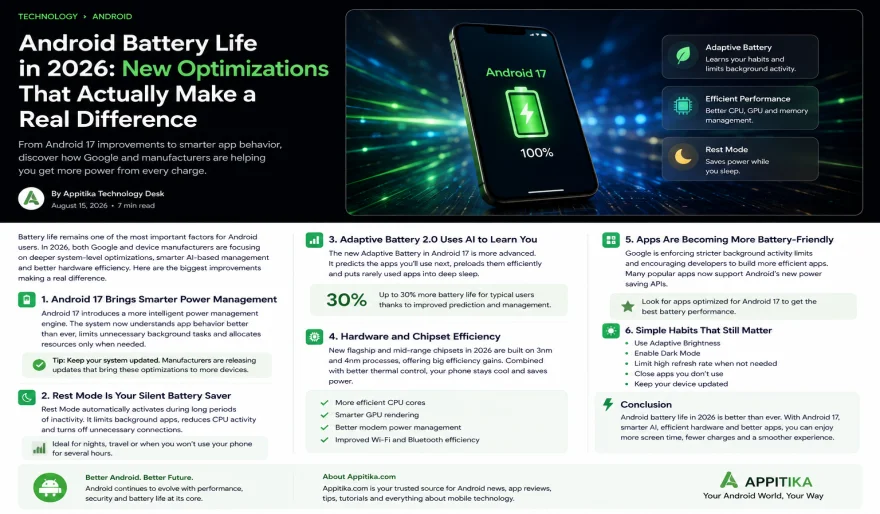
Android Battery Life in 2026: Why Your Next Phone Could Last Longer Than You Expect
By Appitika Technology Desk
Published: August 15, 2026
Category: Android • Mobile Technology • Smartphones
Reading time: 9 minutes
Battery life has always been one of the biggest concerns for smartphone users. No matter how powerful a processor becomes or how impressive a camera system looks, a phone that needs to be charged several times a day can quickly become frustrating.
But in 2026, Android manufacturers are approaching the battery problem differently.
Instead of relying only on larger batteries, the industry is increasingly combining more efficient processors, smarter software, artificial intelligence, improved thermal management and better power control.
The result could be an important shift: Android phones that don't necessarily need dramatically larger batteries to provide significantly better endurance.
The Battery Race Is Changing
For years, smartphone manufacturers competed by increasing battery capacity.
A 3,000mAh battery became 4,000mAh, then 5,000mAh, and eventually some smartphones moved beyond 6,000mAh.
But capacity isn't everything.
A phone with a huge battery can still have disappointing endurance if its processor, display, modem and background applications consume too much power.
Modern Android development is therefore increasingly focused on efficiency rather than capacity alone.
Google's latest Android releases and hardware platforms demonstrate this broader strategy, with operating-system improvements working together with increasingly specialized mobile processors.
The objective is simple:
Make every percentage of battery last longer.
Android 17 Puts More Attention on Efficiency
Android 17 is part of this evolution.
Google's latest Android generation introduces improvements across performance, multitasking, gaming and system behavior, helping devices manage resources more intelligently.
The importance of these changes is easy to overlook.
Every background process consumes some combination of CPU, memory, network and battery resources. When the operating system becomes better at deciding which tasks actually need resources, unnecessary consumption can be reduced.
This becomes particularly important for users who install dozens of applications.
A phone might have social networks, messaging applications, streaming services, shopping apps, navigation tools and games installed — many of which may attempt to perform background operations.
Modern Android increasingly tries to prevent those applications from consuming resources unnecessarily.
AI Could Become an Important Part of Battery Management
Artificial intelligence isn't only about chatbots and image generation.
It can also help smartphones understand how users interact with their devices.
A phone can potentially learn which applications are used frequently, which applications are rarely opened and when certain tasks normally occur.
That information can be used to make smarter decisions about background activity and resource allocation.
For example, if a user opens a particular application every morning, the system may prioritize resources for that application while limiting unnecessary activity from applications that haven't been used for days.
This is a fundamentally different approach from simply telling every application to behave the same way.
The smartphone becomes more adaptive.
Modern Chips Are Doing More With Less Energy
Hardware is another major part of the battery story.
Today's flagship smartphone processors are built using increasingly advanced manufacturing technologies and include dedicated components for tasks such as artificial intelligence, image processing and graphics.
Google's new Tensor G6 processor, introduced with the Pixel 11 family, is a good example of this direction.
Google says Tensor G6 provides a 25% improvement in web-browsing performance and 15% faster application launches compared with the previous generation, while its TPU provides 50% more compute capacity. Google also says on-device AI tasks can be processed up to 3.5 times faster while using up to 3.5 times less energy.
The significance isn't simply that the processor is faster.
It is that performance and efficiency are increasingly being developed together.
A faster chip that completes a task quickly and returns to a low-power state can potentially consume less energy than a slower chip that remains busy for a longer period.
Displays Are Still One of the Biggest Battery Consumers
The screen remains one of the most important components affecting battery life.
High refresh rates, high brightness and large displays can consume considerable energy.
Modern Android phones therefore increasingly use adaptive refresh rates.
Instead of keeping the display at its maximum refresh rate all the time, the device can dynamically adjust the refresh rate according to what is happening on screen.
A static webpage doesn't necessarily require the same refresh rate as a fast-moving game.
Reducing the refresh rate when high smoothness isn't necessary can help reduce power consumption without making the phone feel slower during normal interaction.
AI and Cameras Could Actually Become More Efficient
Smartphone cameras are becoming increasingly dependent on computational photography.
Modern phones perform complicated image processing tasks such as HDR processing, noise reduction, portrait effects, stabilization and AI-assisted image enhancement.
Normally, more processing means more energy consumption.
But specialized hardware can change that equation.
Instead of forcing the main CPU to perform every operation, smartphones can use dedicated image-processing hardware and AI accelerators designed specifically for these workloads.
Google's Pixel 11 series demonstrates how tightly hardware and AI are becoming connected. Google says Tensor G6 is designed to accelerate AI and camera experiences while improving energy efficiency.
The future smartphone camera therefore isn't simply about better sensors.
It is about more efficient computation.
Charging Is Getting Faster — But Efficiency Still Matters
Fast charging has become one of the industry's favorite solutions to battery anxiety.
Modern smartphones can recover a significant amount of battery in a short period, meaning users don't necessarily need to leave their phone connected for hours.
Google's Pixel 11 Pro XL, for example, is advertised as capable of gaining up to 15 hours of battery life from 15 minutes of charging under Google's specified conditions.
But fast charging doesn't solve everything.
A phone that consumes its battery quickly still requires frequent charging.
The ideal combination is therefore:
Longer endurance + faster charging.
This is why software optimization remains just as important as charging technology.
Developers Also Have a Role
Battery life isn't only the responsibility of Google or smartphone manufacturers.
Application developers have a major influence on how much energy Android devices consume.
Poorly optimized applications can perform unnecessary background operations, repeatedly request location information, maintain network connections or consume processing resources even when users aren't actively using them.
Android's increasingly strict background-management policies are designed to reduce this problem.
Developers who optimize their applications can help users achieve better battery life while also improving performance.
For Android developers, battery efficiency should therefore be considered part of application quality.
A beautiful application that drains a phone's battery quickly is not truly optimized.
The Rise of On-Device AI Changes the Equation
There is another important factor: on-device artificial intelligence.
Instead of sending every AI request to a remote server, some operations can be performed directly on the smartphone.
This can reduce network communication and improve response times.
Google's Tensor G6 is specifically designed around this approach, with Google highlighting faster and more energy-efficient on-device AI processing through its Tensor Processing Unit.
For users, this could eventually mean AI features that work faster and more privately while consuming less power than expected.
The smartphone is becoming a miniature AI computer.
Why Battery Health Is Becoming More Important
Long battery life isn't only about how long the phone lasts today.
Battery health matters over months and years.
Lithium-ion batteries naturally degrade through charging cycles and exposure to heat.
This means efficient software and better thermal management can have another advantage: potentially reducing unnecessary heat and stress on the battery.
Users should still follow basic habits:
Avoid excessive heat whenever possible.
Use reliable chargers and cables.
Keep Android and applications updated.
Avoid leaving demanding applications running unnecessarily.
Use adaptive brightness.
Disable features you don't need.
Check which applications consume the most battery.
Small changes can make a noticeable difference over time.
The Future Could Be About Intelligent Energy Management
The most interesting part of the Android battery story isn't a single feature.
It is the combination of several technologies.
AI learns user behavior.
The operating system controls background activity.
The processor completes tasks more efficiently.
The display dynamically adjusts its power consumption.
Dedicated AI hardware handles complex workloads.
Fast charging reduces the inconvenience of low battery.
Together, these technologies create a much smarter power-management system.
The smartphone isn't simply carrying a bigger battery.
It is becoming better at deciding when it should use energy and when it shouldn't.
What Android Users Can Expect Next
Over the next few years, battery improvements are likely to become increasingly difficult to notice as individual features.
Users may simply discover that their phone lasts longer.
They won't necessarily know whether the improvement came from the processor, Android's power management, an AI accelerator, a more efficient modem or an application update.
And that may actually be the best outcome.
Technology is most successful when users don't need to think about it.
The ultimate goal isn't to create a phone with the biggest battery.
It is to create a phone that understands how to use its battery intelligently.
Appitika's Verdict
The Android battery race is entering a new stage.
For years, manufacturers focused heavily on increasing battery capacity and charging speeds. In 2026, the more interesting competition is happening inside the software and silicon: smarter power management, efficient processors, AI acceleration and better cooperation between Android and the hardware.
Google's Pixel 11 and Tensor G6 demonstrate this direction particularly clearly, while Android's broader evolution shows that efficiency is becoming a central part of the mobile experience.
The next generation of Android phones may therefore not need to look dramatically different.
They may simply need to waste less energy.
And if manufacturers continue improving efficiency at the same pace, the smartphone of tomorrow could deliver something users have wanted for years: a full day — and potentially much more — without constantly thinking about the charger.
Appitika Exclusive
This article is originally written for Appitika.com by the Appitika Technology Desk. It is an independent editorial analysis based on current Android developments and official announcements from Google. It is not copied or translated from another publication.
Primary sources: Google Android Developers and Google official announcements.
User Comments (0)
Popular Apps









 Games
Games Entertainment
 Communication
 E-mail
 Security
 Tools
Tools Media
Media Internet
 Finance
 Design
 Education
 IT Tools
 Travel & Local
 Android
 Windows
 Linux
Linux