Android Apps in 2026: How AI Is Changing the Future of Android Applications
13 min read Android apps are entering a new AI era. Discover how Gemini, on-device AI, Android 17 and Google AI Studio are transforming Android development in 2026. August 15, 2026 19:04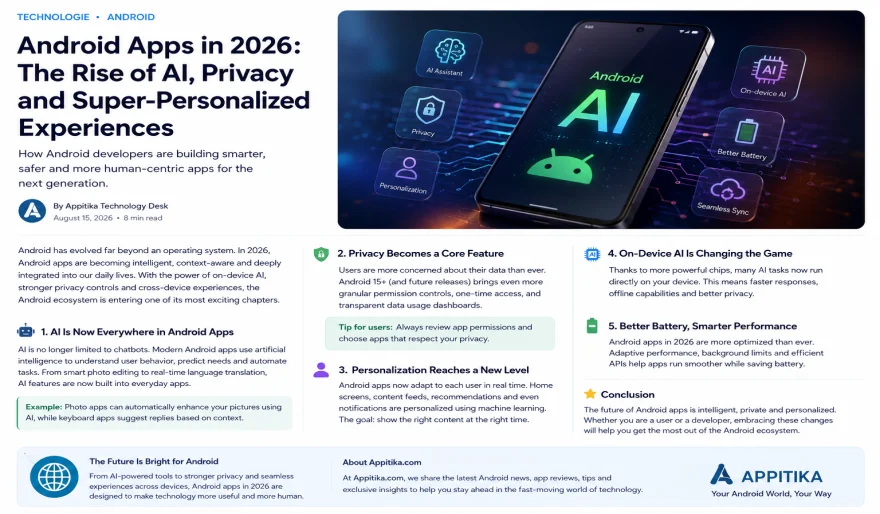
Android Apps Are Entering the AI Era: How Google Is Changing the Way Developers Build Apps in 2026
By Appitika Technology Desk
Published: August 15, 2026
Category: Android • Artificial Intelligence • App Development
Reading time: 9 minutes
The Android ecosystem is entering a new phase, and this time the biggest change is not another redesign or a faster processor. Artificial intelligence is becoming part of the foundation of Android applications themselves.
Google is increasingly moving Android toward what it describes as an “intelligence system”, where smartphones can understand context, automate tasks and assist users across applications instead of simply waiting for users to open an app and perform every action manually.
For Android users, this could make everyday tasks dramatically simpler. For developers, however, it represents something even bigger: a fundamental change in the way mobile applications are designed.
From Traditional Apps to Intelligent Apps
For years, Android applications have followed a familiar model.
You open an application, navigate through menus, select an option and complete a task.
AI is beginning to change that model.
Instead of asking users to understand how an application works, developers can increasingly build applications that understand what the user wants.
Imagine opening a travel application and simply saying:
“Find me a cheap hotel near the beach for three nights.”
Instead of manually entering dates, location, price range and filters, an AI-powered application could understand the request and guide the user through the process.
Google's Gemini Intelligence initiative is designed around this broader concept, including the ability to automate multi-step tasks across selected applications.
This is the beginning of a different Android experience — one where intent becomes more important than navigation.
Google AI Studio Is Bringing AI-Powered Android Development to More People
One of the most interesting developments for Android developers happened at Google I/O 2026.
Google introduced native Android app development directly inside Google AI Studio.
Developers can describe an application idea using natural language, and AI Studio can generate native Android code using Kotlin and Jetpack Compose. Google also announced integrations designed to make it easier to move from an idea to a working application.
This is particularly interesting for independent developers.
A developer could potentially begin with a simple request such as:
“Create an Android application for a restaurant that displays meals, accepts orders, supports delivery and includes an administrator dashboard.”
Instead of starting from an empty Android Studio project, the developer can use AI-assisted tools to create an initial implementation and then continue improving it.
The developer remains responsible for testing, security, architecture and publishing — but AI can dramatically reduce the amount of repetitive work.
Gemini Is Becoming More Than a Chatbot
The biggest misconception about AI on smartphones is that AI simply means having a chatbot.
Google's direction is considerably broader.
Gemini Intelligence is being developed to automate tasks, summarize information and interact with applications. Google says the technology is designed to work across the Android ecosystem, with expansion to devices such as watches, cars, glasses and laptops.
That creates an interesting possibility.
Instead of having separate AI functionality inside every application, Android itself could increasingly become the layer that connects the user, applications and AI.
This could allow users to move between tasks without constantly switching applications.
Android Developers Are Preparing for Agentic Applications
Google's developer strategy is also changing.
At Google I/O 2026, Google highlighted agentic workflows as an important part of the future of Android development.
The company introduced tools designed to allow AI agents to perform development tasks, while Android developers are also being encouraged to create applications that can participate in intelligent workflows.
This could eventually produce applications that do not simply respond to a button press.
Instead, an application could receive a goal and determine several steps required to achieve it.
For example:
Traditional application:
Open → Search → Select → Confirm → Pay.
AI-assisted application:
“Order my usual dinner.”
The AI could potentially understand the request, identify the appropriate restaurant, retrieve the user's preferences and prepare the order for confirmation.
The important difference is not the number of screens.
It is the fact that the user communicates a goal rather than a sequence of instructions.
Android 17 Is Providing the Foundation
Google's Android 17 release also fits into this larger transition.
Android 17 introduces improvements aimed at performance, multitasking, gaming, privacy and security. Google has also introduced features such as floating application windows and improved tools for creators.
These improvements matter because AI applications can be more demanding than traditional applications.
An AI-powered application may need to process images, audio, text or other forms of information while simultaneously handling background tasks.
Better system performance therefore becomes an important part of the AI experience.
On-Device AI Could Become One of Android's Biggest Advantages
There is another important development happening behind the scenes: AI processing is increasingly moving closer to the device.
Modern Android smartphones contain increasingly powerful processors designed specifically for artificial intelligence.
That creates several advantages.
Faster responses
When an AI operation can be processed locally, users may not need to wait for a remote server to respond.
Better privacy
Sensitive information can potentially remain on the device instead of being sent to a cloud service.
Offline capabilities
Some AI functions can continue working even when an internet connection is unavailable.
Lower server dependency
Developers can potentially reduce the amount of information that needs to be processed remotely.
Google is actively encouraging developers to explore on-device inference as part of its intelligent Android application strategy.
Privacy Will Become More Important Than Ever
AI also creates a difficult question:
How much should an application know about its user?
An AI assistant becomes more useful when it understands context, but collecting more information can create privacy risks.
Google has therefore been placing increased emphasis on permissions, transparency and user control.
Android 17, for example, introduces more granular controls around sensitive information, including temporary location access and stronger protections for applications that request user data.
For developers, this means AI cannot simply be implemented as an afterthought.
A successful Android application in the coming years will need to combine:
Artificial intelligence
Strong privacy
Transparent permissions
Efficient performance
Secure data handling
Good user experience
The smartest application will not necessarily be the one that collects the most information.
It may be the one that achieves the most while collecting the least.
The Smartphone Is Becoming a Personal AI Platform
Perhaps the biggest change is happening at the ecosystem level.
Android is no longer limited to smartphones.
Google's strategy increasingly connects phones with watches, cars, laptops, glasses and other devices. Gemini Intelligence is expected to expand across these different surfaces.
This means an application could eventually understand that the user is moving between devices.
A conversation could begin on a smartphone, continue on a smartwatch and finish on a laptop.
The goal is not simply to synchronize data.
The goal is to create a continuous computing experience.
What This Means for Android Developers
For developers, the message is becoming clear:
Building an Android application in 2026 is no longer only about creating screens.
Developers need to think about how their applications can understand context, interact with AI systems, operate across different screen sizes and devices, protect user information and remain efficient.
Google is also pushing developers toward modern Android technologies such as Jetpack Compose and AI-assisted development tools.
This creates an interesting opportunity for independent developers.
Small development teams can now use AI to accelerate tasks that previously required much larger teams.
A single developer can potentially design the interface, generate boilerplate code, build database structures, create APIs, write tests and troubleshoot errors with AI assistance.
But AI does not eliminate the need for developers.
Instead, it changes what developers spend their time doing.
The New Competitive Advantage: Ideas
The technology required to build an application is becoming increasingly accessible.
That means the biggest advantage may eventually become the idea itself.
Thousands of developers can ask an AI to create a basic calculator, weather application or note-taking app.
Far fewer developers will create an application that solves a specific problem for a particular group of users.
This is where independent Android developers have an opportunity.
Local services, specialized business tools, educational applications, productivity utilities and regional solutions could all benefit from AI-assisted development.
The barrier to building software is falling.
The challenge is becoming knowing what software is worth building.
Android's Next Chapter Could Be More Personal
The Android ecosystem is moving toward a future in which applications are increasingly intelligent, contextual and personalized.
Google's Gemini strategy, Android 17, AI Studio and its developer tools all point in the same direction: Android is becoming a platform where AI is integrated into the experience rather than treated as a separate feature.
For users, that could mean fewer repetitive tasks.
For developers, it could mean faster development and entirely new categories of applications.
And for the Android ecosystem itself, it could mark one of the biggest transformations since smartphones became mainstream.
The next great Android application may not be the one with the most buttons.
It may simply be the one that understands what the user wants before the user has to explain every step.
Appitika's Take
At Appitika.com, we believe the next generation of Android applications will be defined by three principles: intelligence, simplicity and trust.
AI should make applications easier to use — not more complicated.
Personalization should make experiences more relevant — not invasive.
And automation should save time — while keeping the user in control.
The Android ecosystem is moving rapidly in that direction, and 2026 could be remembered as the year when AI stopped being an optional feature and started becoming part of the fundamental Android application experience.
Appitika Exclusive
This article is originally written for Appitika.com by the Appitika Technology Desk. It is an editorial analysis based on official Google announcements and current Android developments; it is not copied or translated from another publication.
Sources: Google Android, Google AI Studio and Android Developers official announcements.
User Comments (0)
Popular Apps









 Games
Games Entertainment
 Communication
 E-mail
 Security
 Tools
Tools Media
Media Internet
 Finance
 Design
 Education
 IT Tools
 Travel & Local
 Android
 Windows
 Linux
Linux